Overview
As Product Manager for Global Pricing at bp (2025–present), I picked up Apollo after it had sat on the roadmap for five years without a single market live. Pricing decisions for fuels contracts were made manually, from scattered spreadsheets pulling data from systems never designed to work together.
Apollo is now live in Spain — the original market that had been waiting five years to see it real — with rollout underway to additional markets. Delivery meant rebuilding engineering leadership mid-project, alongside data engineering and a commercial pricing SME, integrated across Power BI, SQL, Figma and Azure DevOps, with SAP and the PROS pricing engine.
The Problem
Apollo had been on bp's Global Pricing roadmap for five years without shipping. It arrived with five years of accumulated expectation, and people who had heard promises before — not a blank canvas. The handover was effectively nothing: my predecessor had tracked dates and status, without shaping direction, discovery or the underlying product decisions.
Before any real progress on Apollo itself, two foundations had to be rebuilt first. There was no documentation — the previous lead engineer, a contractor with informal backing from a senior technical stakeholder, left the architecture and decision history almost entirely undocumented, so we reverse-engineered it from the system itself. And the stakeholder map was too narrow: nobody had brought in Customer Support or Digital Security for a tool about to sit at the centre of live commercial pricing decisions.
Five years of a product not shipping usually means five years of undocumented decisions and an incomplete stakeholder map. Half the early work wasn't building anything new — it was making the invisible visible again.
The Approach
The lead engineer wasn't equipped for the role and held it through an informal relationship rather than being the strongest person for it. A permanent bp data engineer already embedded in the project was clearly the stronger technical lead — so, mid-flight and against real risk, I didn't renew the contractor and moved the permanent engineer into the lead position instead. It paid off: we stayed on schedule despite the change, and he's since worked with me across several subsequent projects.
Two further calls shaped delivery. First, instead of building for multiple European markets at once as originally planned, I made the case to focus entirely on Spain — against pushback from a senior pricing leader who wanted broader progress. The pattern that had kept Apollo stuck for five years wasn't lack of ambition; it was never landing. Second, rather than wait for a PROS pricing engine integration that wasn't ready to build a launch on, Apollo shipped in two honest phases: an interim workaround launched in Spain on schedule, followed by a publicly committed three-month follow-up for the full PROS integration — delivered exactly on the revised date.
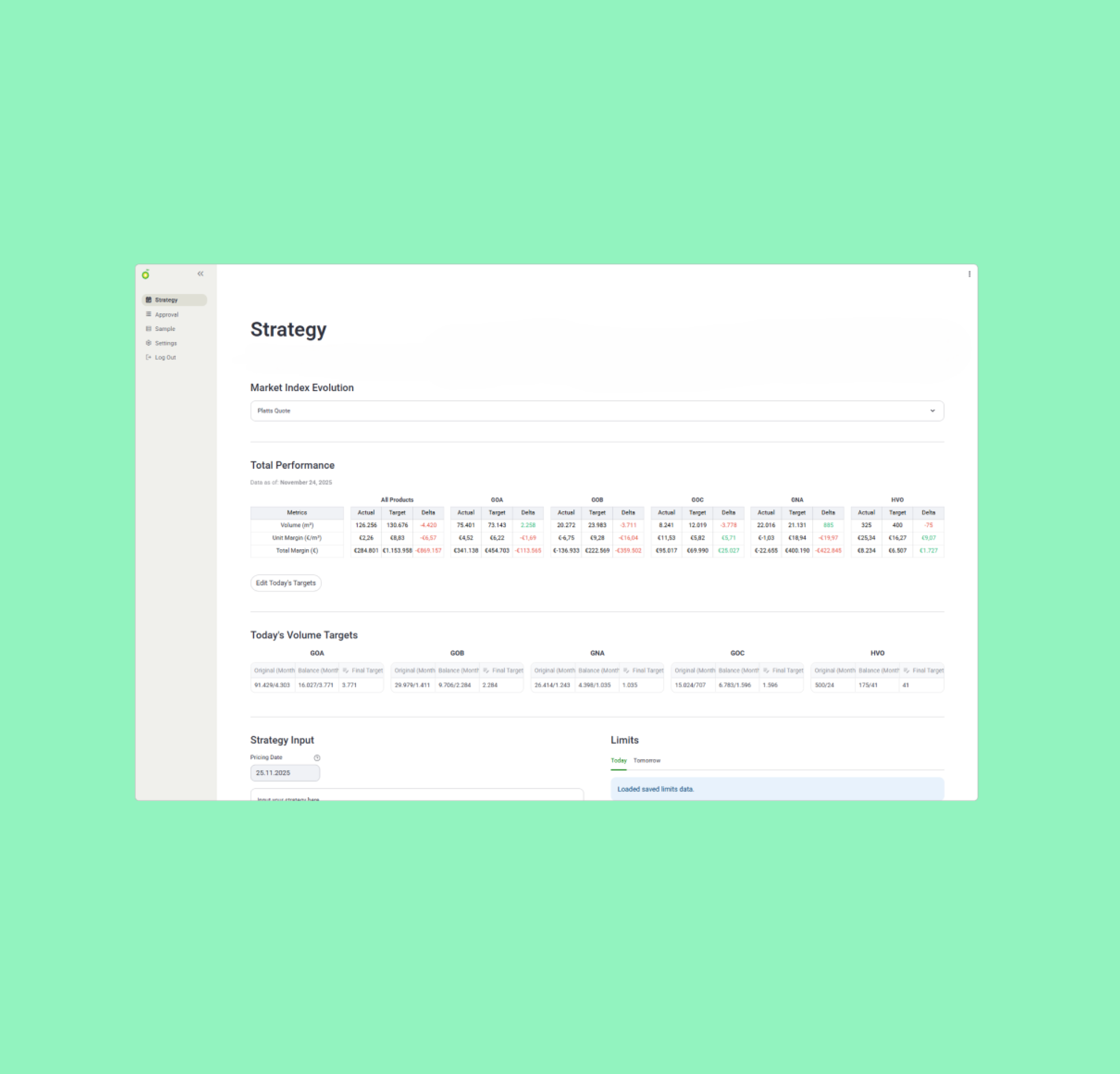
Structured discovery with the Spanish pricing analysts reframed the whole product: the assumed friction was missing data, but the real friction was fragmented trust — too many separate places to check and reconcile before feeling confident making a call. Design and engineering worked in parallel with discovery, not after it, with early prototypes in front of analysts before anything was built. The redesign centred on three consistent screens — a daily Strategy overview, a Decisions queue analysts work through, and Market trends leaders check — all sharing the same recommendation logic, reasoning and decision record. Every recommendation ships with its reasoning attached — cost floor, competitor signal, volume commitment — so analysts see why, not just what, and approve or adjust manually with every choice recorded against their analyst ID.
The Outcome
Apollo launched successfully in Spain, and the headline number wasn't a top-down estimate. The pricing SME built the ~£1.5m annual value bottom-up: cataloguing every new analytical activity the team could now do, costing each one per litre herself, consolidating totals by month, and normalising out seasonality and one-off shocks before annualising. Hundreds of analyst hours were reclaimed from manual work no longer needed, freed up directly for the analysis Apollo now enables.
The next phase is scaling beyond Spain — a different problem to the one that shaped version one. The easy path would be a near-identical, market-specific instance per country, repeating the manual, bespoke pattern Apollo was meant to replace. What's being built instead is a genuinely reusable core with configurable business rules per market, treating scalability as a design problem in its own right.
Scope of Work
- End-to-end PM ownership from an undocumented, five-year-stalled roadmap item to a live product
- Reverse-engineered architecture and decision history with no formal handover
- Rebuilt technical leadership mid-project, replacing a contractor with a permanent engineer
- Expanded the stakeholder map to include Customer Support and Digital Security
- Scoped delivery to a single market (Spain) before multi-market rollout
- Phased PROS pricing engine integration: interim workaround plus a publicly committed follow-up, delivered on the revised date
- Discovery-led redesign across three core screens: Strategy, Decisions, Market trends
- Bottom-up value model built with the pricing SME: ~£1.5m annual value, hundreds of analyst hours reclaimed
- Planned and edited the product launch video with the pricing SME and product sponsor
- Now scaling to additional markets via a reusable, configurable core
Want the full picture? The case study below walks through the process, the decisions and the outcome in more detail.
View Case Study ↗