Overview
Deal Compass is a dual-capability internal product for large B2B commercial organisations. It combines a customer segmentation engine — built as a reusable, governed product asset — with a deal optimisation layer that consumes segmentation outputs to generate pricing and rebate guidance at the point of decision.
The core design principle: guidance that helps teams make better decisions, without removing their authority to make them.
The Problem
Large B2B organisations face a structural tension between commercial growth, pricing consistency, and governance. The issues on the ground were compounding: inherited segmentation that teams couldn't explain or defend, pricing logic that didn't reflect regional cost or supply conditions, discounts set once and rarely revisited, and decision-making fragmented across roles with no shared reference point.
Outcomes weren't tracked after deals closed, so learning didn't compound. The underlying diagnosis wasn't people making bad decisions — it was structures that forced trade-offs without shared logic.
Approach
The strategic decision was to treat segmentation as a reusable product asset, not a one-off calculation supporting a single use case. This meant designing two tightly linked capabilities as one product: segmentation as the foundation, deal optimisation as a downstream consumer of its outputs.
Customers are described using a defined attribute framework — each attribute answering a specific question about behaviour or value, grouped into business-meaningful categories with thresholds validated through exploratory data analysis. Scores aggregate at the parent level and map to a small number of main segments (strategic intent) and more granular sub-segments (operational precision).
Segmentation deliberately produces two distinct outputs: a transparency output with full attribute, score and segment detail — for review and governance — and a operational output with only what downstream systems need. Nothing flows downstream until the operational output passes a formal approval gate.
Deal Optimisation
For each customer, the system combines sub-segment, customer type and current pricing model to derive a recommended pricing model and rebate. Recommendations are shown transparently inside the existing deal and rebate profitability tool — the interface teams already work in, not a new one they'd have to adopt.
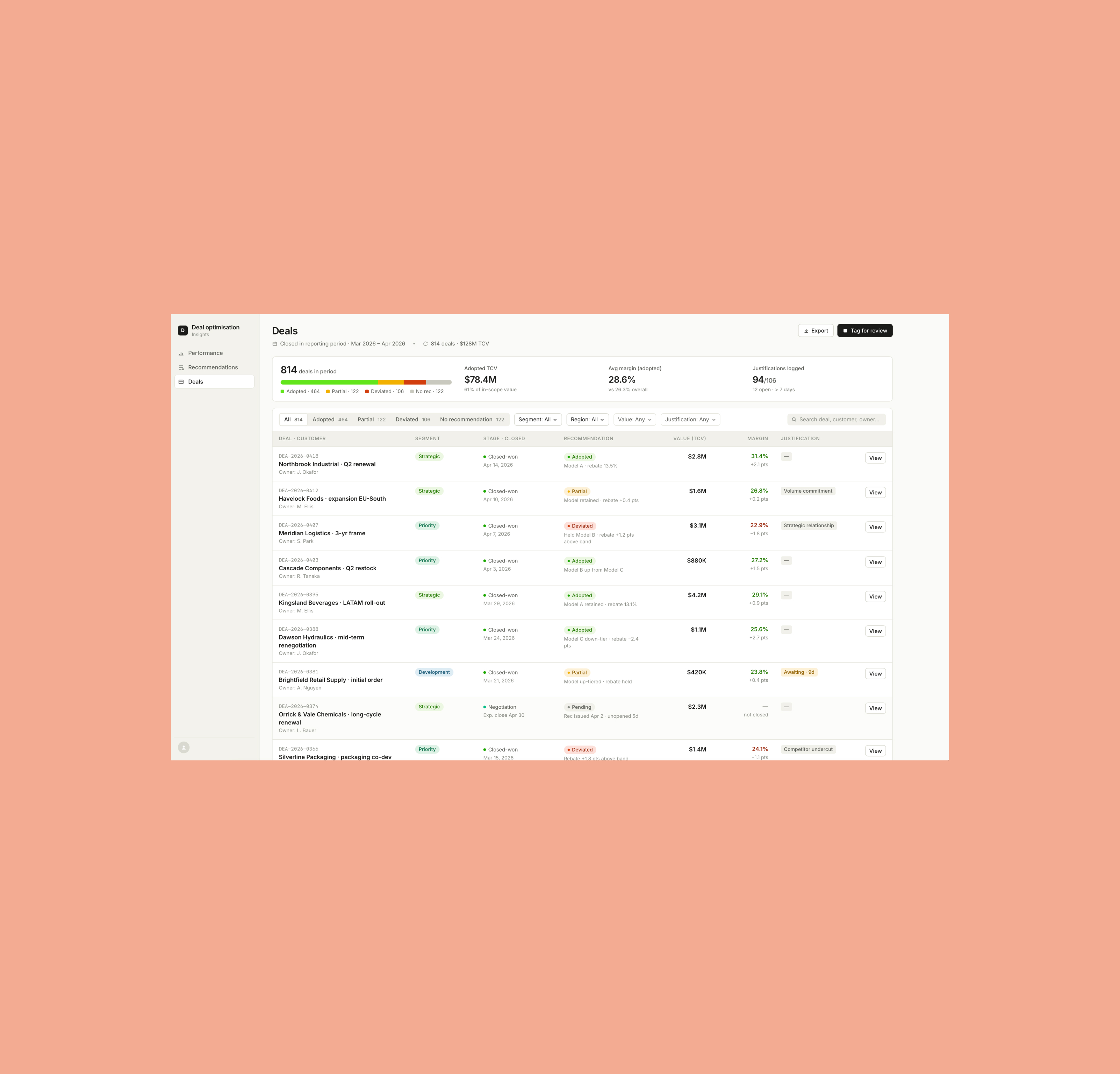
Alerts flag where a proposed deal diverges from the recommendation, where rebates drift from segment norms, and where profitability thresholds are at risk. Sales can deviate, but must acknowledge and justify. Approval authority and delegation rules are untouched. A dedicated performance report tracks adoption, deviation reasons, rebate alignment over time, and margin impact — closing the loop so guidance evolves with real outcomes.
Scope of Work
- End-to-end PM ownership from discovery through to delivered designs
- Segmentation attribute framework with scoring, grouping, and EDA-validated thresholds
- Two-output architecture: transparency view for governance, operational view for downstream use
- Cycle-based governance model: fixed cadence, rolling windows, tiered change types, formal approval gate
- Segmentation Health report — dedicated governance surface for interrogating each cycle before release
- In-flow deal guidance embedded inside the existing deal/rebate profitability tool
- Deal Optimisation Performance report closing the adoption and outcome feedback loop
- Stakeholder alignment across sales, commercial operations, finance and pricing teams
Want the full picture? The case study below walks through the process, the decisions and the outcome in more detail.
View Case Study ↗